


|
Become a member of 1planet1ocean at no charge.

Receive VIP inviations to special events, our newsletter, ExpeditionDispatch, live updates from the field, and more!

|
Automatically receive 1planet1ocean updates by subscribing to our RSS feed. Subscribe to our Home Page Feed below. See all our feeds. Subscribe...it's easy!
Subscribe to 1planet1ocean's
Home Page Feed
Need help with this?
|
|
|
New Species Found,
New Records Set
Beneath the Bering Sea

BERING SEA, Alaska -- On August 1, 2007, Kenneth Lowyck took his tiny sub to one of the expedition's "shallower" dives, to about 700 feet into the Bering Sea's Pribolof Canyon, where he extended the sub's manipulator arm and collected rock containing a tiny, unassuming white sponge. Months later, there would be no doubt: This was a new species, named Aaptos kanuux, the word "kanuux" being the Aleut word for "heart," in honor of the Bering Sea's canyons, considered to be the heart of the Bering Sea. It was the first time the genus Aaptos has ever been documented in the Bering Sea. The discovery comes on the heels of Earth Day and will likely herald future announcements of new species discovered during last summer's Greenpeace expedition to the Bering Sea's two largest canyons.
 |
|
1planet1ocean president David Guggenheim participated as a science advisor and submarine pilot. Analysis continues, but already it has been noted that half of the 14 deep sea corals documented during the expedition were never before seen in the Bering Sea. Nor were two thirds of the 20 or so sponge species documented. And the expedition provided the first record of black coral of any kind and the first record of stony coral in the Bering Sea. NOAA biologist Robert Stone participated in the expedition and co-authored a recent paper with Greenpeace scientist John Hocevar presented the new findings at the Alaska Marine Science Symposium. You can see a copy of the report online. The expedition was undertaken to collect information needed to inform conservation policies by the North Pacific Fisheries Council. The expedition team documented numerous examples of extensive damage to corals by fishing trawlers, which essentially clearcut the bottom with their nets.
Read More on Oceandoctor's Blog
You're Invited! See Never-Before-Seen Video from the Bering Sea Expedition
To celebrate the Marine Fish Conservation Network's 15th anniversary, Dr. David Guggenheim will be the featured speaker aboard a cruise along the Potomac River in Washington, DC on May 7. As the first human being to pilot a submarine into the Bering Sea’s two largest canyons he will show rare footage from Greenpeace’s recent scientific expedition to these extraordinarily beautiful and mysterious ocean depths. The Marine Fish Conservation Network is a coalition of over 190 national and regional environmental organizations, commercial and recreational fishing groups, aquariums, and marine science groups dedicated to conserving marine fish and to promoting their long-term sustainability. Download Invitation (PDF)

|
|

With a Terabyte (1,000 Gigabytes) of high-definition video, photographs and other data, along with numerous biological samples, now making their way around the world to scientists, policymakers and public forums, new insights and perspectives are emerging as the hard work of reviewing this vast volume of new data moves forward. The science team and sub pilots have departed Esperanza, which is continuing west along the Aleutian Island chain, continuing important outreach to local communities. The ship will eventually continue west to Japan.
Before departing Dutch Harbor, the science team/sub pilots made the first public presentation of its findings, including imagery and videos, to the community of Unalaska. The following day, members of the community were invited aboard Esperanza during an Open House to meet with the crew and see the ship up close.
Though the at-sea portion of the expedition has concluded, much work lies ahead in the analysis and review of the information collected. In addition, planning is underway for events to bring the new imagery and insights to the public, so stay tuned. Also, the team continues to review chart data regarding the pinnacles reported to be in the Zhemchug Canyon area which purportedly rise within 20 feet of the surface. Such features would certainly be biologically important, so the search will continue.
Now Available:
Pribilof and Zhemchug Canyons revealed diverse and complex ecosystems, rich with corals, sponges, fish and other marine life. They also revealed striking human impacts from trawlers, damage that was documented during the expedition. For a reflection on the conclusion of the expedition, read David Guggenheim's latest OceanDoctor blog post entitled, "A Sea Turtle is Born in Alaska."
The Esperanza icarried two manned submersibles, a remotely-operated vehicle (ROV) and an international research team to the Bering Sea for a three week survey of Zhemchug and Pribilof Canyons,to map and document deepwater corals living at depths of more than 1,000 feet. The expedition was conceived of and was led by Greenpeace.
|
Posted Earlier :
|

The Esperanza began its 2-day steam south and endured gale-force winds and 15-foot seas along the way, but all are well and grateful for the successes along the way. The team achieved a total of 25 sub dives during the expedition, well-exceeding expectations for this part of the world where weather is typically unforgiving.
The team collected nearly a Terabyte (1,000 Gigabytes) of high-definition video, photographs and other data, now being archived, cataloged and distributed. Also collected were numerous coral, sponge, and other invertebrate samples which are being prepared for distribution to scientists around the world for further analysis.
Despite intense effort and late-night searching, the Esperanza was never able to locate the pinnacles reported to be in the Zhemchug Canyon area, pinnacles which are reported to rise within 20 feet of the surface. The team was prepared to scuba dive and video/photo-document these features, however this mystery will have to wait for a future expedition.
Now Available:
Zhemchug Canyon has revealed a diverse ecosystem with interesting and complex interrelationships. It's also a location where large numbers of squid can be found at depth. Read more on David Guggenheim's OceanDoctor blog.
The Esperanza is carrying two manned submersibles, a remotely-operated vehicle (ROV) and an international research team to the Bering Sea for a three week survey of Zhemchug and Pribilof Canyons,to map and document deepwater corals living at depths of more than 1,000 feet. The expedition was conceived of and is being led by Greenpeace.
Read more about the expedition on our Bering Sea Expedition Page, including 7 ways you can stay in touch with the expedition.
Read More...
|
|

Before rough seas rolled in on Tuesday, the team aboard Esperanza was able to complete six manned submersible dives and three ROV dives at Zhemchug Canyon, considered the largest canyon in the ocean. The subs worked close to their maximum depth of 2,000 feet while the ROV worked at its deepest depth ever, around 3,000 feet. A variety of corals has been observed, documented and collected at Zhemchug Canyon, including the beautiful pink Swiftia pacifica pictured above.
Zhemchug Canyon has also revealed an intricate ecosystem whose inhabitants depend upon small holes or rises in the otherwise flat, silty bottom, including "flatfish holes," depressions made by halibut, flounder, sole and skates, and drop-stones, rocks and boulders that fall from melting icebergs above. Read more about this unique place on David Guggenheim's OceanDoctor blog.
The Esperanza has also been searching for three reported pinnacles -- summits of underwater mountains or seamounts -- that reach as close to 20 feet from the surface. Reports of these pinnacles are decades old and position information is imprecise, so the search continues.
The Esperanza is carrying two manned submersibles, a remotely-operated vehicle (ROV) and an international research team to the Bering Sea for a three week survey of Zhemchug and Pribilof Canyons,to map and document deepwater corals living at depths of more than 1,000 feet. The expedition was conceived of and is being led by Greenpeace.
Read more about the expedition on our Bering Sea Expedition Page, including 7 ways you can stay in touch with the expedition.
Read More...
|

|
|


 |
The Esperanza crew had an opportunity for a brief shore leave on St. Paul Island on Friday (August 3) where they visited a fur seal rookery. Populations of fur seals are down dramatically.
Photo by David E. Guggenheim
|
Continued favorable weather and few mechanical problems means that the team aboard Esperanza has been able to complete 14 manned submersible dives at Pribilof Canyon. On Saturday (August 4), Esperanza arrived at Zhemchug Canyon to explore this, the largest undersea canyon in the world, much larger than the Grand Canyon. Within the first few minutes of the deepest ROV dive yet, more than 3,000 feet down, the team discovered corals, including pink "bubblegum" corals along with other soft corals.
Earlier, during the final dives at Pribilof Canyon, the team documented numerous corals, but also evidence of extensive trawling damage in the area. Read David Guggenheim's account in his OceanDoctor blog.
The Esperanza is carrying two manned submersibles, a remotely-operated vehicle (ROV) and an international research team to the Bering Sea for a three week survey of Zhemchug and Pribilof Canyons,to map and document deepwater corals living at depths of more than 1,000 feet. The expedition was conceived of and is being led by Greenpeace.
Read more about the expedition on our Bering Sea Expedition Page, including 7 ways you can stay in touch with the expedition.
Read More...

|
Deepwater corals, like this sea whip (Halipteris willemoesi) photographed on Sunday by Timo Marshall, thrive in the deep waters of Pribilof Canyon Esperanza
|
Thanks to great weather, state-of-the-art equipment and a top-notch crew, it has been a productive weekend for the team aboard Esperanza which arrived on site at Pribilof Canyon Saturday morning (July 28) when David Guggenheim and Michelle Ridgway made the first tandem dive in two DeepWorker submarines into Pribilof canyon to a depth of just over 1,000 feet and began to document a fascinating diversity of life, including a variety of corals, anenomes, sponges and fish. On Sunday, the ship visited a second site in Pribilof Canyon where John Hocevar and Timo Marshall completed a successful tandem dive, documenting more corals and successfully collecting a number of specimens with DeepWorker's manipulator arm for analysis by scientists around the world.
Already, the Greenpeace-led team has accumulated nearly 16 hours of bottom time (8 hours per sub), more than all of the previous research done in this region combined. The subs' high-definition video cameras have already collected over 120 Gb of data. The subs are performing linear transects which will then be analyzed on the video. Twin lasers spaced 20 cm apart allow accurate analysis of the size of organisms encountered.
The Esperanza is carrying two manned submersibles, a remotely-operated vehicle (ROV) and an international research team to the Bering Sea for a three week survey of Zhemchug and Pribilof Canyons,to map and document deepwater corals living at depths of more than 1,000 feet. The expedition was conceived of and is being led by Greenpeace.
|
The sea anenome, Liponema brevicornis,photographed here by David Guggenheim on Saturday, July 27 at a depth of 620 feet in Pribilof Canyon (The two red dots are from onboard lasers used to assist in estimating size. The lasers are 20 centimeters apart.)
|
|
|


|
|


The Expedition to the Bering Sea officially got under way as the M/V Esperanza departed Dutch Harbor, Alaska on Friday, July 27 at 4pm Alaska Daylight Time. The Esperanza will steam through the night -- for roughly 15 hours -- to its first destination, Pribolof Canyon near the Pribolof Islands in the Bering Sea. The first DeepWorker dives are scheduled for Saturday morning.
In June, an international team of researchers and conservation specialists recently completed a week of intensive training and preparations for this Greenpeace-led expedition to Alaska's Bering sea. The Esperanza is carrying two manned submersibles, a remotely-operated vehicle (ROV) and the research team to the Bering Sea for a three week survey of Zhemchug and Pribilof Canyons, specifically to map and document deepwater corals living at depths of more than 1,000 feet.
These corals, some nearly two thousand years old, are vital components of the Bering Sea's rich and unique ecosystem. Unfortunately, these corals are at great risk, ending up in fish trawling nets as "bycatch" or "incidental take," the unintentional harvest of one species while fishing for another. Many tons of corals have been destroyed by indiscriminant trawling gear which scrapes the bottom and sides of seamounts -- underwater mountains -- for fish.
It is hoped that the data collected during this expedition will help advance our scientific understanding of these deepwater coral communities and be helpful to policy makers as well, leading to more effective conservation measures. A Scientific Advisory Panel is advising the project, including representatives from Scripps, the Smithsonian, the St. George Island Ecosystem Office, MCBI, Oceana, Texas A&M, and Nova Southeastern. 1planet1ocean president David E. Guggenheim will be serving as a sub pilot and scientific advisor.
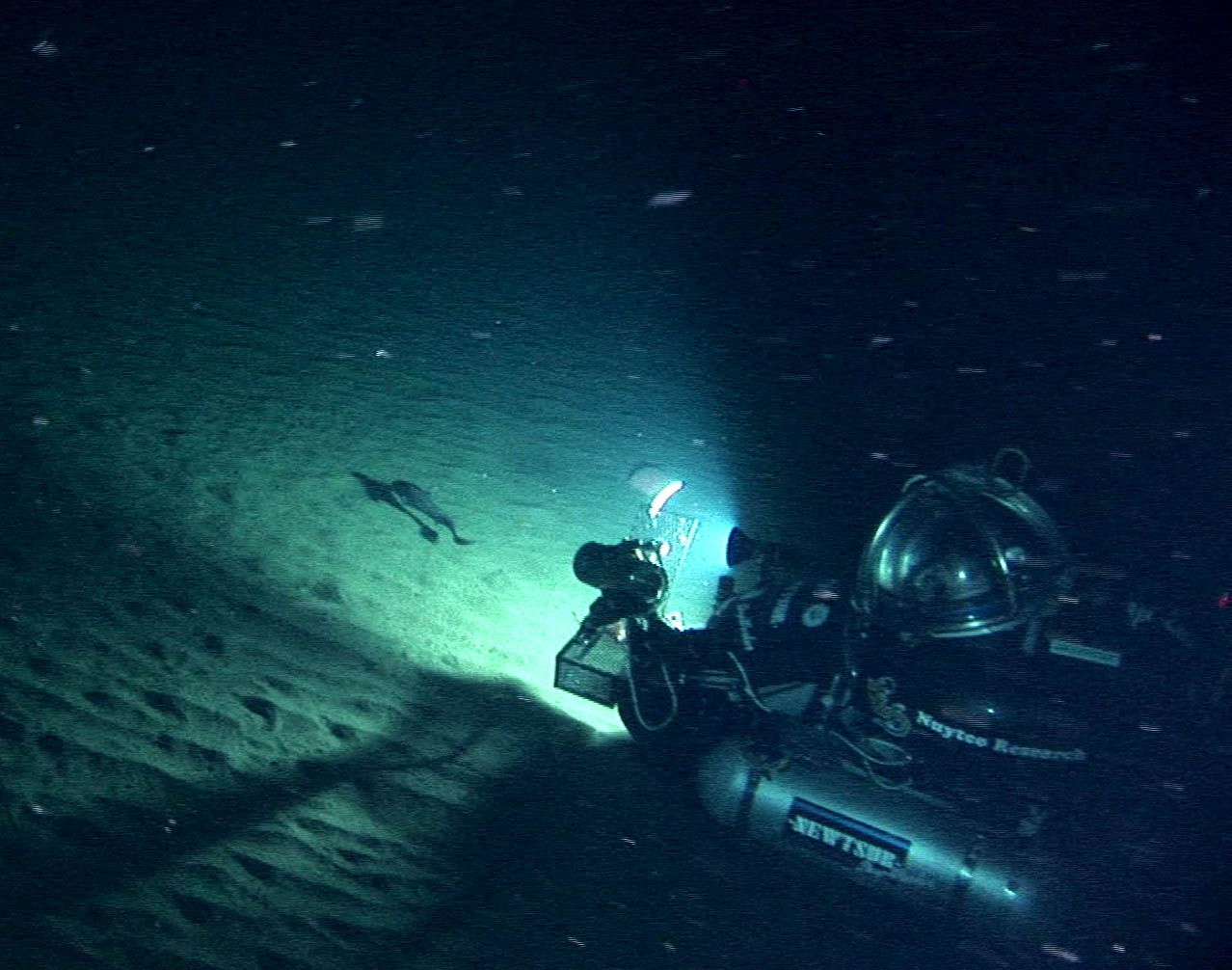
The expedition will be using two DeepWorker submarines, one-person mini-subs, untethered, that are capable of a depth of up to 2,000 feet. Each sub is equipped with a high-definition video camera, a manipulator arm for collecting samples, sonar for navigation and is always in contact with the surface using through-water (acoustic) communications.
DeepWorker's cabin recirculates the air, using carbon dioxide scrubbers similar to what's used in spacecraft, providing up to 80 hours of life support. A typical dive lasts 4-6 hours.
See the sidebar (right) for 7 ways you can stay in touch with the expedition.
Sub Pilots for Bering Sea Expedition aboard M/V Esperanza in British Columbia during June 2007 Preparations |
You Can Help!

You can help support our work in the Bering Sea by pledging your support to Greenpeace, whose leadership and vision has made this expedition possible.
|
|
|
|
|
You already know Alaska's big, but do you know just how big it is? It's not 'til you get in the water that you can truly appreciate just how big Alaska really is. David Guggenheim's OceanDoctor Blog puts "The Ginormous State" in perspective as the start of the Bering Sea Expedition nears.
|
|

Seven Ways to Follow the Expedition. You can participate in the Expedition to the Bering Sea from anywhere in the world. Here are five ways to track the expedition's progress:
1 Check out our Expedition Tracking Page for an interactive Google map showing M/V Esperanza's position, current weather conditions, and a live webcam from the bridge.
2 Join 1planet1ocean and receive email dispatches via satellite from the ship. Membership is free -- just complete a Not ready to join? No worries. You can simply to our newsletter and expedition dispatches.
3 Subscribe to our Bering Sea Expedition Feed which will automatically provide you with updates any time this page is updated.
4 Subscribe to David Guggenheim's where regular updates will be posted.
5 Get updates on Twitter. Twitter is a social networking and "micro-blogging" service that allows users to send and receive updates via SMS, instant messaging, email, and the Twitter website. Follow "OceanDoctor" on Twitter (latest updates appear below):
6 Our "ExpeditionCasts™" podcast series kicks off with coverage of the Bering Sea Expedition. Hear and see updates from the field, delivered to your computer or iPod automatically through iTunes or this site.
7 And, of course, don't forget to check in for updates on which contains a wealth of information on the Bering Sea and Alaska.

.
|
|


|